Friday, April 2, 2010

David Kirkpatrick is blogging about the SculptCAD Rapid Artists Project


The freelance writer and journalist David Kirkpatrick has been posting about the SculptCAD Rapid Artists project on his WordPress blog. His blog is very well developed with posts going back to Jan.2008. Topics include Arts, Business, Politics, and Technology. Some of the recent posting are on the topics of Invisibility Cloaks, Google in China, and iPads. There is also a nice list of other blogs and web sites of interest.

Wednesday, March 31, 2010

Art & Seek drops in to talk with the ScultpCAD Rapid Artists

Shane Pennington talking with Jerome Weeks from KERA/Art & Seek

Reporter Jerome Weeks from KERA/Art & Seek dropped by the SculptCAD studio to talk with some of the artists involved in the SculptCAD Rapid Artists project. He was there for over 2 hours patiently recording the techno geek terminology and the arty babble. Hopefully he got enough intelligent, understanable dialoge to post something on Art & Seek.

On a side note, I think all the artists benefited from having to put into words what they have been doing in the world of 3D computer modeling.

Tuesday, March 23, 2010

The Twisted world of 3D sculpting


This opportunity to work with the SculptCAD Radip Artists has been great. I am really getting comfortable using the few tools that I have chosen to focus on, and not hitting myself over the head for not knowing more about ALL the tools at hand. When I see people like Nancy Hairston or Heather Gorham work with this program, they just pull out tools, whip them around and wallah! It makes me yearn to have more time to play, but the Drop Dead due date for sending our sculptures to the printer is April 14th.

Wednesday, March 10, 2010

Developing a feel for the 3D world


In the real world, your clay never just disappears. But in the 3 D computer world, your hard work can just simply vanish, which is what happened today. Of the 3 hours I put into my project, I only have about 15 minutes of work to show for it. GRRR!

On the other hand my feel for using the sculpting tool is starting to feel much more like reallish sculpting.

Sunday, March 7, 2010

Color Correct Photographic Reproductions

After 4 failed attempts at photographing the drawings in the Book Page Collection, and getting sad color reproduction, I finally found a friend that has one of those top of the line Epson scanners. With in an hour I had all the drawings scanned in beautiful living color. They are now posted on my Flickr page.

Friday, March 5, 2010

It's Worth the Risk Parking


Alison Starr

It was on one of those cold rainy days that we are having so many of, when I turned the corner and saw the sign for Mokah Coffee Bar and Mokah Art Gallery. Cold, wet, needing hot coffee and a good dose of art I ambled inside.

No Parking Any Time is the title of the group show that is up through March 6th. Kathy Lova, Alison Starr and Du Chau have filled this surprisingly will put together gallery space with sculptures and wall installations that are derived from found objects.

Du Chau

Each artists is working with a source material that is commonly found in our everyday environment, such as sticks, stuffed animals or plastic shopping bags. These base materials have been transformed through various processes to become something new but still recognizable.


Kathy Lovas

This juxtaposition creates a wide variety of tactile sensations and narratives. Du Chau's porcelain tree branches convey nature's beauty and it's fragileness. Kathy Lovas' plastic rapped bunnies expose the scary interior of what we consider to be cute and cuddly. Alison Starr uses her sewing skills to transform pounds of plastic shopping bags into beautiful icons of mass consumerism.

So even though the card says No Parking Any Time, ignore that. Grab a hot cup of Joe and spend some time in the gallery.


Saturday, February 27, 2010

Make Space: Installation/Open House at La Reunion TX 2010


Brad Ford Smith
It was a beautiful blue sky, puffy cloud day, perfect for the Make Space: installation event at La Reunion TX. I got up there early to do a few finishing bits to my sculpture and clean up around the site. Then I spent the rest of the day talking to people, petting dogs, and enjoying the sun shine.

Below are photos of some of the sculptures made by the other artists for this years event. If the names are high lighted they link to the artist's web site.


David Blood and Oliver Bradley


Scott Horn


Unfortunately I did not get a photo of Sandra Groomer's installation, but there should be some posted at the La Reunion TX site soon.

Friday, February 26, 2010

Privet Sculpture Project Construction Day 3


All the arches are in place, 12 in all, spanning 40 feet. Sadly, the photographs really don't capture it very well at all.

I'll be out there early on Saturday, Open House 2-4 to add a few elements around the main arch.

These are the flying buttresses that were added for stability. The privet when freshly cut is very bendable. Only a few branches broke during construction. As the wood dries is becomes harder and more apt to brake and split. Over all the structure is very stable. I am expecting the wood to weather very well over it's year long existence. The bailing wire might be an issue with rust, so I'll beef that up on Saturday.

Wednesday, February 24, 2010

Privet Sculpture Project Construction Day 2


Despite the cold and rain, things are progressing. 4 1/2 of the 7 arches are in place. They need to be tweaked and fattened up a bit. I am also adding some side arches at the gate opening for stability.

The bundles are tied together with bailing wire, which was donated to the project by Susan Giller, an artist that is known to create strange bunny people with wire.

Privet does not have stickers in the normal definition of the word. What it has are numerous pointy bits along the branches that are the stubs of old dead twigs. These twigs can be very sharp.

Tuesday, February 23, 2010

A few days working at SculptCAD


I have been working with the Free Form program for a couple of days now, mostly focusing on making the duck that is part of the tutorial, but I have learned enough to generate this first 3 D model of my sculpture "Chicken Neck Johnson" for the SculptCAD Rapid Artists project. It still needs a lot of work before it is ready to be put through the 3 D printer.

Monday, February 22, 2010

At the End of the First Day of Construction on the Privet Sculpture Project

At the end of the first day of construction I learned that not all privet can be used the same. If the branch has any elbows it won't bend smoothly. The long shoots that grow straight up in one season are ideal for the ridged bundled arches that the PSP requires.

First Stake in the Ground for the Privet Sculpture Project

The structure will be staked to the ground using thick privet branches. It will be interesting to see what condition they are in after a year in the dirt. The dirt at this location is on about 10" deep then you hit lime stone, which is the reason this area is called Chalk Hill. The photo also shows some of the long privet branches that have been harvested to create the arched structure.

Sunday, February 21, 2010

Location for the Privet Sculpture Project

The opening for Make Space: Installation at La Reunion TX is this Saturday, Feb. 27th. With all the rain and snow it has been hard for any of the artists to get out there, but I do have my sculpture sited now, and I have started the framing out of the structure. Above is the concept drawing superimposed at the site.

There has been some interesting issues around using privet as a building material, I'll blog about that later. Right now I need to get into my muddy boots and rain coat, pack up the truck and head out to La Reunion TX.

Saturday, February 20, 2010

The Beam Plank & Flitch proposal for the Henderson Art Project


This is one of three Urban Timber Sculptures that Beam Plank And Flitch submitted to the Henderson Art Project. We focused on a minimalist approach that strikes a balance between the natural form and texture of the tree trunks and a graphic subtractive sculpture.

Thursday, February 18, 2010

Privet, Basic Structure and Seed Distribution


The structure and seed zones of privet

Privet growing in the wild sends out branches from a central root ball. It has corresponding small branches that sprout along the main branch. As the main branch grows longer it bends, making an arch. The small branches on the top of the arch grow towards the sun light while the branches on the underside dry up and snap off, leaving rows of small stubs. These stubs are reinforced over the seasons to form a thorn like defense. This pattern of the branch arching, growing and branching out repeats every season resulting in the main branch becoming a series of arches that can extend over 10 feet in length (as observed at La Reunion TX).

With each season, new branches sprout from the root ball and grow straight up, using the older branches as support. Once they have cleared the leafy privet canapé, the small side branches begin. The seeds and new leaves will only form on new growth. The long clusters of hard round seeds tend to be located on the farthest tips of the branches where they can be seen by animals and whipped about in the wind.

Cutting a branch usually results in a growth spurt around the stump and along the branch. Cutting a branch at the base of the plant tends to multiple the amount of new branches sprouting up from the root ball.
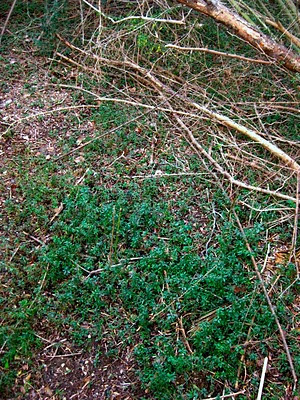
New sprouting seeds

Cutting all the branches down to the base allows sun light to reach the unsprouted seeds, this combined with a little rain water will activate all the seeds.

Tuesday, February 16, 2010

Spreading the Seed

Frass, Droppings, Spore, Poop... What ever you call it, this is a big stinking pile of privet seeds.

One privet bush can produce thousands of seeds every year. These hard round black seeds have a multitude of ways of finding fertile ground. First is the structural nature of the bush itself. It grows in long arching branches that sprout from a central root ball. These branches drop seeds away from the root ball onto new open ground. The branches are also very wiry so in high winds they can act like whips to fling seeds further a field. Due to the small round shape of the seeds, they are easily washed into storm drains and creeks, this being probably the most common form of seeding in urban areas. Birds and some animals can eat the seeds, which are resistant to the acids in the digestive system, so they are excreted later in perfect condition to sprout in new locations.

Please note that privet seeds are slightly poisonous to humans, but they will kill a horse if eatten them.

Monday, February 8, 2010

Art Statement for SculpCAD Rapid Artists program


With access to the Rapid Cad technology and its incredible array of tools and casting mediums, I instantly had visions of producing my very own version of the “Homer”, a car designed by Homer Simpson that was so outlandishly stuffed with add-ons that it caused the finial collapse of Powell Motors.

So, with that in mind, I have tried to focus on learning how the Rapid Cad program works, and how to blind this technology with my own artistic direction, resulting in a sculpture that breaks new ground and makes historical sense. I have of course spent a lot of time just playing; this program seems to encourage that sort of “what if I do this” activity. In the end I have slipped the Rapid Cad into my normal creative process, which begins with lots of drawing on paper, those are then reprocessed and reprocessed to create a composite drawing “Chicken Neck Johnson”. This drawing is scanned onto the Rapid Cad desktop, where it is fleshed out, manipulated, and reprocessed. The resulting 18” X 18” X 6” sculpture is a composite of shapes that I love working with, plus a humorous animal reference, which I credit to the playful, toy making aspects of the Rapid Cad program.

The sculpture is made from an almost transparent red plastic. The Rapid Cad program has allowed me to shell the sculpture so that it is hollow and very light. The walls vary in thickness, which causes the red color to become more intense in the areas where the plastic is thicker and almost water clear where the walls are thinner. The shelling process has also allowed me to create a bottom heavy counter balance, which allows the neck and head to be extend in an giraffe like appearance with an almost transparent head.

Sunday, February 7, 2010

The Privet Sculpture Project: Cutting Research


This is the edge of a native grass field that has never been plowed. It is slowly being overrun but a tidal wave of privet.

Anne Albagli and I went out to La Reunion Tx today. It was again damp, muddy and slick, but after whacking away at privet for an hour, the cold damp didn't feel so bad.

I brought along a cornucopia of saws, hedge clippers, and hatchets to test out. Branch trimmers work the best for anything smaller than an inch in diameter. Bigger than that you need a pull saw. Those come in lots of shapes and teeth counts. Lots of teeth seem to work the best. The privet is to wiggly for a standard push saw or an axe to efficiently cut lots of privet. I did notice areas where people had used a chainsaw. Agin the wiggliness of the branches resulted in heavily splinter stumps.


Friday, February 5, 2010

Art in the District 2010: posting on Art Seek

Posted a little blurb about the Art In The District 2010 art fair on Art and Seek. Just hoping to get the word out a bit more.

I really feel like the local/Texas media coverage for this art fair and the Dallas Art Fair, which by the way ran full page adds in Art in America and Art News for the last two months, was severely lacking. After the grand opening events for the two new performance centers in the Dallas Arts District a few months ago, you would think having 56 nationally recognized galleries set up camp across the street from the DMA would cause some buzz with the Art District crowd...

Thursday, February 4, 2010

Dallas Art Fair posting on Art & Seek

I just posted an article about the second annual Dallas Art Fair on Art and Seek, click here. I am heading down there tomorrow to hopefully load up my eyeballs on some hot relevant artwork. Then I'll pop over to the new Art In The District 2010 art fair. Perhaps if I am lucky I will OD on art.

Sunday, January 31, 2010

Make Space: Installation meet up at La Reunion TX

Old road almost swallowed up by privet

A good portion of the artists for this years Make Space: Installation met up at La Reunion Tx to scout out locations and inspirations for their installation projects. It was thick with slippery mud but other wise a very nice day.

Sarah Jane introduced me to Shreyas Krishnan, who describes himself as an ecologist with an interest in how invasive plants effect the natural evolution of amphibians and retiles. Of course I was very happy to hear about the invasive plant interest. I am hoping to include some of his knowledge in the documentation on the Privet Sculpture Project.

Two of the other artists, Anne Albagli and Nicle Cullum Horn are using privet in some form in their installations, so I'll be posting about some of their experiences here, too.

SculptCAD Rapid Artists role call


Here are the links to the artists that are involved in the SculpCAD Rapid Artist Program being sponsored by SculpCAD. Nancy selected a group of artists that work in a wide range of styles, mediums and disciplines to see what artists would do with a 3-D computer sculpting tool that is normally used by draftsmen to design medical implants and consumer good like tennis shoes.

Monday, January 25, 2010

More Local Privet Problems


Seems like as soon as I submitted my Privet Sculpture proposal to La Reunion privet started coming out of my ears.

Lots of people like Shreyas Krishnan and organizations like the Texas Master Naturalists are very passionate about privet. Shreyas sent in this link to an article in the Dallas Morning News about the problems of removing privet from the Great Trinity Forest, (video by Scott Miller) Texas Invasives.org is actually creating a map that tracks the spread of privet across Texas.

Saturday, January 23, 2010

A Duck made in the world of SculptCad


We had our first SculptCad Rapid Artists meeting today. We all introduced ourselves and commented on how our first tutorial projects were going, Note the duck pictured above. I'll post the links to all the participating artists in the next post.

On site with Make Space: Installation

Drove out to meet up with Sarah Jane Semrad and some of the other artists that are part of the La Reunion TX Make Space: Installation. The La Re Volunteers have been working had this past year to clear out new trails and spaces. I wish I had known, I could have collected a lot of privet.

Anyway here is the list of artist in this years show:
Anne Albagli, Oliver Bradley/David Blood, Sandra Groomer, Nicole Cullum Horn, Scott Horn, Kevin Obergon, Brad Ford Smith.

Thursday, January 21, 2010

Privet Gone Wild at La Reunion TX

I am one of the artists in the 2010 La Reunion TX Make Space: Installation. My project is to make an architectural sculpture using privet. Privet is a plant from Asia. As you can see in the photo, it is a very aggressive and is quickly overtaking the Dallas Metroplex. Just about any creek or flood zone you look into you will see privet growing, acres and acres of privet. In this project I will be testing the viability of using the privet as a green and renewable building material.

Friday, January 15, 2010

Frist Day as a ScultpCAD Rapid Artist


Had My first chance to play with the Free Form 3 D computer sculpting program today. Mostly just poking holes and making cheese doodles. I can see that this program has a lot of similarities to the tools found in Adobe Photoshop. But it seems a bit more user friendly. Then add the Phantom desktop carving tool which is a pencil like mouse that simulates the feel of carving into real material.

Next week I'll start using the tutorial to help me learn the program. I can see

Proposal for La Reunion Tx, Making Space: Installation


Privet: A non-native gone wild

During the time that I have spent at the La Reunion property it has always struck me how much the non-native shrubbery called privet has taken over the landscape. This plant, originally from Asia is very aggressive and hardy. It is used widely in the DFW metroplex as a decorative bush around houses and commercial builds. Unfortunately a single privet bush will produce 1000s of berries each year. These berries are often washed into the city’s storm drains which empty into the local creeks and streams. The result is that most of the creek banks and flood zones in the DFW area are now overgrown with privet. Once a privet bush is established, simply cutting it down cannot kill it. The root ball is like a Hydra, it will send up several new braches for each one that is cut off, totally replacing the old growth within a few short months. Privet is pushing out the native plants that native animals, birds and insects feed upon. This is creating vast areas of monocultures that only support other aggressive plants like poison ivy and insects like mosquitoes

Privet: An experiment in repurposing

The branches of privet are very long and thin, but also surprisingly strong. In this way privet resembles plants like the ocotillo, cane and bamboo, all fast growing plants that are widely used as building materials. Based on these natural characteristics, a team of artists will “harvest” privet branches from the La Reunion property and use them to construct a sculpture. This sculpture will be of a design and scale that calls explores the architectural validity of using privet as a building material. Documentation and photos will be taken throughout the project. After 12 months the sculpture will be dismantled, at which time documentation will focus on the condition of the sculpture and the structural stability of the privet.

If this field test proves that privet can be used as stable building material, it could turn the urban privet plague into a valid source for sustainable and green building materials

Thursday, January 14, 2010

David Bates at Dunn and Brown Contemporary

This was originally posted on Art and Seek in January 2010, but it seems to have been lost when they reformatted.


I stopped in at Dunn and Brown Contemporary to see the new show by David Bates, Themes and Variation. Of the 24 paintings on view only 3 are not of flowers. So it's safe to say that this is a show of floral still lives. It is not breaking any new ground in the world of painting, in fact it is looking backwards into the history of painting, one of the things that David Bates does with skill and passion.

There are strong connections with the stone solid flowers of Marsden Hartley, Picasso's late decorative work, and Manet's paintings of cut flowers. All artists that demonstrate an obvious love for the medium of oil painting.

From this platform of art historical connections David Bates launches into a series of paintings that are thick with paint, rich with deep color, and bold with mark making. When all combined, this show of Themes and Variations is a strong must see for those who love oil paint.

Sunday, January 10, 2010

Dallas Museum of Art Photo Meet-Up


Hooked up with the DMA Meet-up to take photos around the museum. The group was small this time around, but we had a great time talking about posting work on the DMA Flickr site, managing our Flickr accounts, and I found out about The Art of Photography Podcast.
Then we pulled out our cameras and hit the museum for about 20 minutes, finishing up back in the media lab for some fresh photo show and tell. So it was a pretty straight foreword event this time around, but in the past they worked with pinhole cameras and even played with blue screens. Both of which Nicole Leigh said they would probably do again in the future.